Anthropic launched Claude Ship on November 23, and the feature getting the most attention is the one where Claude posts a real approving review on your pull request, the kind that counts toward merging.
Should you let it? Yes, for a narrow set of changes, after you’ve watched it in observe mode for a couple of weeks. Everything else should still go through a person.
What Claude Ship includes
Claude Ship bundles three tools that run on GitHub pull requests. Code Review (generally available) scans a PR and leaves inline findings ranked by severity, without approving or blocking anything on its own. PR Steward (beta) pushes commits to fix failing checks, merge conflicts, and review feedback, and Anthropic’s docs say it won’t approve or merge PRs.
Claude Approvals (beta) is the only piece that can approve. It runs as a GitHub check named “Claude Approvals” driven by a policy file in your repo, so deciding whether to let an AI approve your PRs comes down to how you write that file. The Claude Ship docs cover the rest.
Requirements and billing
Before you write any YAML, check whether Claude Approvals can run on your repo, because otherwise the policy file does nothing. You need a Claude Team or Enterprise plan on github.com (including GitHub Enterprise Cloud). It won’t run for organizations using Zero Data Retention, the HIPAA configuration, customer-managed encryption keys, FERPA, or Access Transparency settings.
Claude Approvals has no base fee, but the classifiers your policy calls bill on tokens, and any policy that reads Code Review can trigger billed reviews. That includes observe mode: observe stops enforcement, not billing. Code Review and PR Steward both draw from your org’s usage credits, and an Owner can set spend limits in Organization settings under Usage.
How the policy file works
The policy lives at .claude/approvals.yml in the root of your repo, and only the copy on your default branch counts. Each rule defines paths (the files it covers), a verdict (whether Claude approves, comments, or blocks, plus how many seats must sign off), and an optional override list of exceptions evaluated top to bottom where the first match wins.
Two behaviors matter before you write your own rules. First, every matching rule applies and the strictest one wins, so if a docs rule lets Claude approve and a sensitive-paths rule asks for two people, a PR touching both gets two people. Second, if Code Review errors out or times out, the policy stays on the rule’s own verdict instead of falling through to a looser override. Put the strict verdict on the rule and the looser one in override.
Watch out for seats too. The PR’s author fills a seat just by opening the PR, so a bare seats: 1 passes with no outside reviewer. When you want someone other than the author, write from: [humans, "!pr/authors"].
A real .claude/approvals.yml you can start from
This is the policy I’d start with on a small team repo. Once Claude’s review passes, it lets Claude approve docs, very small diffs, and Dependabot bumps on its own. Everything else needs a person.
version: 1
mode: observe
rules:
  - purpose: "Code takes one reviewer who is not the author. Claude can approve Dependabot bumps and tiny diffs alone once its review passes."
    paths: ["**", "!docs/**", "!**/*.md"]
    verdict: { claude: comments, seats: [{ count: 1, from: [humans, "!pr/authors"] }] }
    override:
      - { if: "ALL pr/authors = bot:dependabot AND claude/code_review = pass", verdict: { claude: approves, seats: 0 } }
      - { if: "pr/diff_lines <= 5 AND claude/code_review = pass", verdict: { claude: approves, seats: 0 } }

  - purpose: "Docs and Markdown merge on a passing Claude review. Otherwise one reviewer who is not the author."
    paths: ["docs/**", "**/*.md"]
    verdict: { claude: comments, seats: [{ count: 1, from: [humans, "!pr/authors"] }] }
    override:
      - { if: "claude/code_review = pass", verdict: { claude: approves, seats: 0 } }

  - purpose: "Dependency files changed by a person take a reviewer who is not the author."
    paths: ["**/package.json", "**/package-lock.json", "**/pnpm-lock.yaml", "**/yarn.lock", "**/go.{mod,sum}", "**/Cargo.toml", "**/Cargo.lock", "**/pyproject.toml", "**/requirements*.txt"]
    if: "ANY pr/authors != bot:dependabot"
    verdict: { claude: comments, seats: [{ count: 1, from: [humans, "!pr/authors"] }] }

  - purpose: "Sensitive paths always take two people who are not the author. Claude never approves here."
    paths: ["**/.claude/**", "**/.github/**", "**/auth/**", "**/payments/**", "**/migrations/**", "**/CLAUDE.md", "**/AGENTS.md", "**/REVIEW.md", "**/CODEOWNERS", "**/Dockerfile", "**/*.tf"]
    nested: inherit
    verdict: { claude: comments, seats: [{ count: 2, from: [humans, "!pr/authors"] }] }
The first rule is the default: everything outside of docs needs one approval from someone who didn’t write it, and Claude only comments. Two overrides let Claude approve alone once its review passes, either when every author is Dependabot or when the whole PR is five changed lines or fewer. That five-line override is the one I’m least sure about. I included it for typo fixes in code comments and strings, so if it makes you uneasy, drop it to 2 or delete the line.
The second rule covers docs/ and Markdown files, letting them merge on a passing Claude review and falling back to one human reviewer if the review fails or times out.
The third rule guards dependency files touched by a person. Without it, someone could change one line in package.json, slip under the five-line override, and merge without a review. The if clause fires whenever anyone other than Dependabot authored the PR, so human dependency changes always need a reviewer. Swap the paths for the package managers your repo uses.
The fourth rule locks down sensitive paths: auth, payments, migrations, CI workflows, infrastructure, and the review rules themselves. Those always take two people who aren’t the author, whatever the review says. Because the strictest rule wins, this holds even when a five-line diff or a Dependabot PR touches one of those paths (including Dependabot’s GitHub Actions bumps under .github/). Adding nested: inherit keeps the rule active if someone adds a subdirectory policy later.
Two caveats before you copy this file. Rule 4 deadlocks on a two-person team because each PR only has one person who isn’t the author, so change count: 2 to count: 1 if your team is that small. And update the paths to match your codebase: **/auth/** won’t protect anything if your auth code lives in src/session/.
Make Dependabot only open minor and patch bumps
The policy file can’t read version numbers. No condition knows the difference between 1.4.2 → 1.4.3 and 1.x → 2.0. So if “minor bumps only” is your line, enforce it in Dependabot instead, by telling it to ignore major updates:
# .github/dependabot.yml
version: 2
updates:
  - package-ecosystem: "npm"
    directory: "/"
    schedule:
      interval: "weekly"
    ignore:
      - dependency-name: "*"
        update-types: ["version-update:semver-major"]
Now the only Dependabot PRs that can hit rule 1’s shortcut are minor and patch updates. Major upgrades are where breaking changes show up, and you handle those yourself.
Keep a few caveats in mind with the Dependabot shortcut. It trusts anyone who can trigger Dependabot or influence what it writes. If a person pushes a commit to a Dependabot branch, they become an author, ALL pr/authors = bot:dependabot stops matching, and the PR requires a human again. And after Dependabot force-pushes a rebase, Claude Approvals sometimes can’t confirm Dependabot is still the sole author, so it falls back to asking for a person. That’s annoying, though it fails safe.
Run it in observe mode first
With mode: observe on line two, the check reports what the policy would decide, Claude approves nothing, and the check ends neutral (which GitHub treats as passing).
- Add the file in a normal PR from a branch in the repo, not a fork. Even in observe mode, a PR that changes a policy file gets a real check. Wait for Claude’s comment confirming the policy file is valid, then merge.
- Leave your existing GitHub branch protection alone. While the file observes, the “Claude Approvals” check gates nothing, so your current required approvals remain the safety net.
- Watch the check titles for a week or two. Each one starts with “(observe mode)” and tells you what would have happened (“Would be approved by Claude,” “Would pass; no approval from Claude,” or a “Waiting on human review” message listing who’s missing).
- Log every PR the policy would have approved on its own in a simple three-column sheet: PR link, would-have-approved (yes/no), and “was that OK?” If even one answer is no, tighten the rule that let it through before going live.
- Check for files no rule matches. Any uncovered file has no reviewer requirement, so a PR made only of those files can merge unreviewed. The
"**"rule above prevents that, so re-check if you ever narrow it.
Going live
Once the log is boring, flip it on:
- Delete the
mode: observeline and merge that PR. - Wait five minutes, then comment
@claude approvals rerunon any open PR whose check title still starts with “(observe mode)” or says “Observe mode ended.” - In your GitHub branch protection, turn on “Require status checks to pass before merging” and add “Claude Approvals.” Pick the Claude app as its source, not “any source.”
- Turn on “Dismiss stale pull request approvals when new commits are pushed.” Without it, GitHub can keep counting Claude’s old approval after a new push lands, until Claude Approvals gets around to withdrawing it.
- Test it. Open a PR that changes something under
.claude/and confirm the check blocks the merge until two people approve.
I’d also keep GitHub’s own required approvals at one or more. GitHub doesn’t accept an author approving their own PR, so either Claude (where the policy allows it) or a teammate has to provide that approval. At zero, an author can merge before the check has even reported.
What’s safe to auto-approve and what isn’t
Safe to let Claude approve (after a passing review)
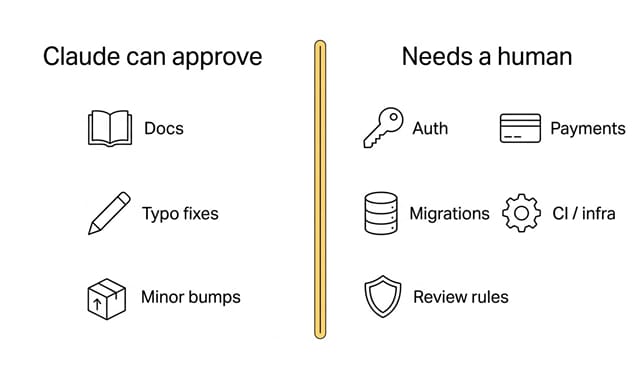
Start with the low-blast-radius stuff people rubber-stamp anyway. Docs, READMEs, guides, and changelogs are the easiest yes: if something slips through, the worst case is a clunky sentence you fix in the next PR. The same goes for obvious typo fixes in comments or user-facing strings, as long as you keep the diff-line cap tight.
Minor and patch dependency bumps from a bot you control belong in the same bucket. Once Dependabot is limited to non-major updates and your test suite is a required check, those PRs are the most tedious ones in the queue. Letting Claude handle them gives your teammates that time back for changes that need real review.
Still needs a human
Anything that can break security, money, or production data stays behind human review. Authentication, authorization, and session code can open up your whole app in three lines, and payments or billing carry the same risk with real money attached. Database migrations are just as unforgiving because they are painful to undo once they run in production.
Infrastructure and repo config need the same wall around them. A small edit to .github/workflows, a Dockerfile, or Terraform can leak secrets or weaken what every future PR gets checked against. That goes double for the review rules themselves (.claude/approvals.yml, CLAUDE.md, AGENTS.md, REVIEW.md, CODEOWNERS): if an agent can loosen its own guardrails, you don’t have guardrails. Major dependency upgrades and any dependency change made by a human also stay on the human side, since breaking changes need someone who knows how the app uses that library.
Things the policy can’t see
Before you assume a rule has you covered, keep in mind what .claude/approvals.yml is blind to. No condition in the policy file can read your CI or test results, so your test suite still has to be its own required status check in GitHub. It also can’t inspect draft state, PR titles, dates, file contents, or semantic version numbers (which is why you handle semver in Dependabot instead).
The subtlest blind spot is who asked for the work. "!pr/authors" only checks GitHub accounts. If your team has an agent opening and pushing PRs under a bot or machine account, you are not listed as an author on that PR, which means you can approve your own agent’s code alone. If that’s how you work, bump the required reviewers above one on anything that matters.
I made the same argument in how to safely use AI coding agents: give the agent a small, clearly defined job and hard limits on everything outside it. It’s also how you’d set up Claude Code on your own machine. In Claude Code permission modes explained, I suggest letting it run freely on safe operations and keeping approval prompts on risky ones. A policy file does the same thing for merging PRs.
Where PR Steward fits (and how to stop it)
PR Steward pushes fixes to your PR. It won’t approve or merge, but it does add commits, and each new commit changes the code your reviewers are signing off on.
If a repo Owner turns it on, it starts when a PR is opened, reopened, or marked ready. By default it skips drafts, fork PRs, PRs opened by bots, and authors without write access. There’s also a manual mode where it only starts when someone comments @claude steward.
To stop it on a PR, comment:
@claude stopOr remove the claude-pr-steward-watching label. Owners can switch it off or limit it for future PRs in Settings, under Code.
One cost warning: PR Steward bills on tokens and has no spend limit until an Owner sets one. Set one before you turn it on for a busy repo. The PR Steward docs have the full list of triggers and settings.
If you want to try the workflow on your own PRs before rolling anything out to a team, Claude Code v2.1.330 or later has a /ship command that commits, opens a PR, reviews it, and watches it for fixes from your terminal. You still merge it yourself.
So, should you let it auto-approve?
For docs, typos, and minor bot bumps, yes, once observe mode has shown you it makes the same calls you would. Those are the PRs that wear reviewers out, and you won’t miss reviewing them.
For anything touching auth, money, data, CI, or the rules themselves, no. A passing review doesn’t guarantee Claude read every changed file, and approving the wrong PR there costs far more than ten minutes of a teammate’s time.
Put the file above in observe mode, keep the log for two weeks, and only loosen a rule when the log gives you a reason. For the full key reference, see the Claude Approvals docs.
Claude Ship and Claude Approvals FAQ
Can Claude Code Review approve or block a pull request?
No. Code Review only leaves findings. Claude Approvals is the piece that can post an approving review, and only where your .claude/approvals.yml policy allows it.
Is observe mode free?
No. Observe mode doesn't enforce anything, but a policy that reads claude/code_review can still start billed Code Reviews while it observes.
Does Claude Approvals work on GitLab or Bitbucket?
No. Claude Approvals runs on github.com, including GitHub Enterprise Cloud, for Team and Enterprise plans.
How do I stop PR Steward on a pull request?
Comment @claude stop on the pull request, or remove the claude-pr-steward-watching label.
Can the policy only auto-approve minor dependency updates?
Not directly, since no policy condition reads version numbers. Configure Dependabot to ignore semver-major updates, then let the policy trust Dependabot PRs that pass review.
This page may contain affiliate links. Please see my affiliate disclaimer for more info.